Kai Yeow Maa
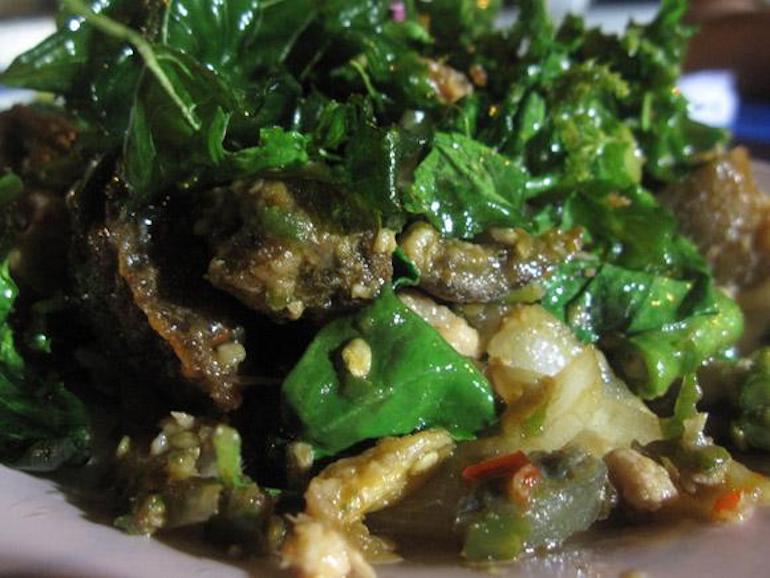
Salad whose main ingredient is century egg (egg preserved for months in a mixture of salt, lime and ash), mixed with coriander, fish sauce and lime juice.
1,82 €
Spice Level
Description
Kai Yeow Maa, literally "horse urine egg" (a name referring to the ammoniac smell of the preservation process), is the Thai version of the Chinese century egg. These duck or chicken eggs are preserved for several weeks to months in an alkaline mixture of lime, wood ash, salt and sometimes clay. This process completely transforms the egg: the white becomes gelatinous and translucent with an amber to black color, while the yolk takes on a grey-green hue and a creamy texture. In salad, the eggs are cut into quarters and mixed with fresh cilantro, shallots, chilies, fish sauce and lime juice. These fresh ingredients balance the powerful aroma of the eggs and create a surprisingly harmonious dish. The creamy texture and deep umami flavor of the eggs make them a delicacy appreciated by connoisseurs.
History & Origin
The century egg is a Chinese invention over 500 years old, probably originating from Hunan province during the Ming Dynasty. Legend has it that a farmer discovered duck eggs naturally preserved in slaked lime and found them delicious. In Thailand, this technique was introduced by Chinese immigrants and adapted to local tastes. Thais created their own way of enjoying these eggs in salad, adding fresh herbs, fish sauce and lime to balance the intense flavors. The Thai name "Kai Yeow Maa" (literally "horse urine egg") refers to the characteristic ammoniac smell of the preservation process.
Main Ingredients
- Lime
- Cilantro
- Shallots
- Œuf du siècle
- Fish sauce